Challenges in Medical Device Miniaturization and Assembly
Medical devices are increasingly undergoing miniaturization, driven by the need to improve patient comfort and enable more precise procedures. However, reducing device size also increases the complexity of medical equipment assembly.
Traditional manufacturing methods such as micro injection molding and CNC machining face limitations in terms of lead time, manufacturing flexibility, and cost. As a result, researchers and manufacturers require solutions capable of efficiently producing miniature components with extremely tight tolerances.
3D Printing for Medical Devices
3D printing has emerged as a transformative technology within the medical device industry. Unlike traditional manufacturing methods, 3D printing eliminates the need for complex tooling, helping reduce production costs and shorten manufacturing lead times.
However, not all 3D printing technologies are suitable for medical device applications, especially when ultra-high precision and biocompatibility are required.
Overcoming Limitations with PμSL Technology
Projection Micro Stereolithography (PμSL) technology from Boston Micro Fabrication addresses many of the limitations found in conventional 3D printing methods.
Advantages of PμSL technology include:
- Rapid production of miniature components with high precision and accuracy using biomedical-grade plastics
- Resolution down to 2 μm with accuracy of ±10 μm
- Capability to match injection molding performance for manufacturing complex medical devices
The technology enables manufacturers to produce highly detailed and functional medical components at micro-scale dimensions.
Enhancing Endoscopy Design
Endoscopic devices, commonly used for diagnostic procedures, have also experienced significant miniaturization. However, reducing component size often increases manufacturing complexity and production time.
By leveraging micro 3D printing, endoscope manufacturers can:
- Reduce the number of assembly steps
- Accelerate production processes
- Integrate connectors and channels directly into the device design
This integration allows more efficient fluid delivery and gas flow pathways within the endoscopic system.
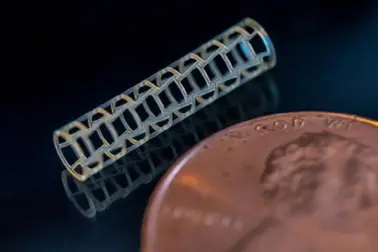 Stent Kardiovaskular
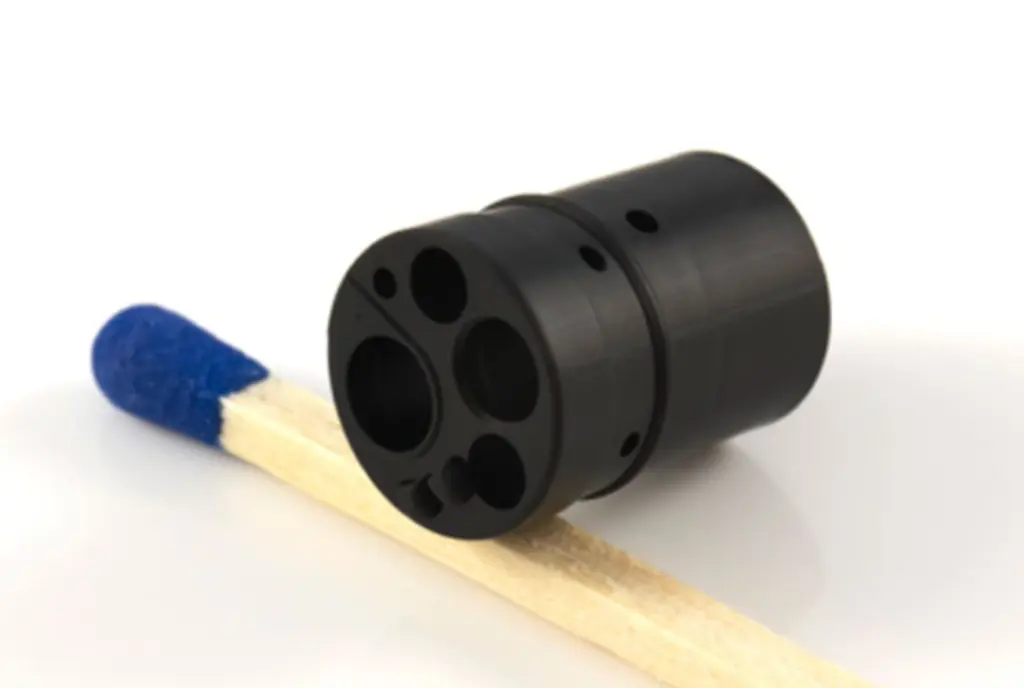 Cangkang Endoskopi
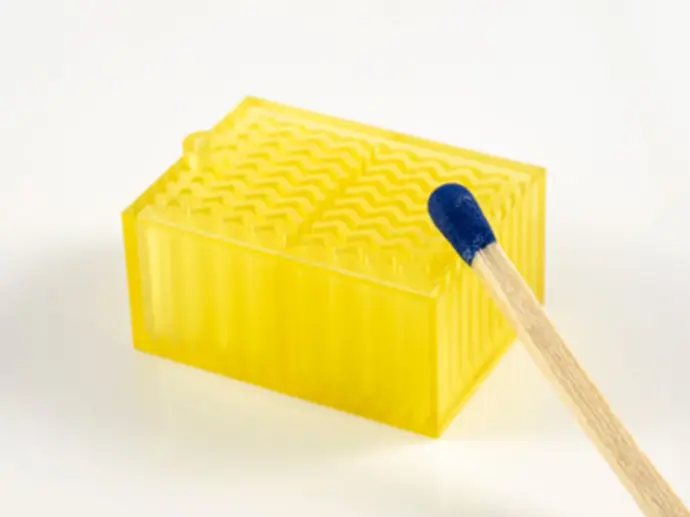
Penukar Panas untuk Pembekuan Darah
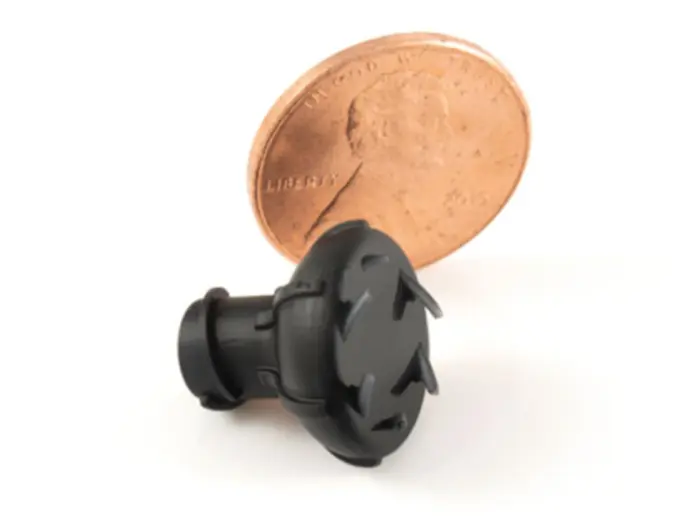
Jarum Suntik Spiral
Expanding the Applications of PμSL
Beyond endoscopy, PμSL technology shows strong potential for manufacturing a wide range of medical devices.
Applications include:
- Cardiovascular stents
- Blood heat exchangers
- Spiral syringe needles for minimally invasive surgery
- Valves for gene sequencers
- Lab-on-a-chip (LOC) devices
The versatility of PμSL technology could drive major advancements across the medical device industry.
Conclusion
The advancement of 3D printing technologies—particularly PμSL—is transforming the medical device manufacturing industry.
By addressing the challenges of miniaturization, assembly complexity, and biocompatibility, micro 3D printing enables researchers and manufacturers to develop smaller, more precise, and more efficient medical devices.
With its ability to deliver ultra-high resolution and injection molding-level precision tolerances, PμSL provides a powerful manufacturing solution for modern medical device production.
As the medical industry continues to adopt this technology, breakthrough innovations that improve patient treatment and healthcare outcomes are expected to accelerate.
Micro 3D Printer Supplier in Indonesia
Maha Chemicals is the official distributor of Boston Micro Fabrication MicroArch 3D printers in Indonesia.
With its advanced capabilities, BMF MicroArch technology can support the development of smaller, more precise, and more sustainable medical devices.
Contact us for more information about micro 3D printing solutions for medical and industrial applications.
Need more support?
Let's connect!
We'll get in touch within 1 working day.
HQ Office & Laboratory
51 Tuas West Drive
Singapore 638415
Operating Hours
Monday – Friday | 8:00AM – 5:00PM
Contact
sales@dash-asia.co