Spectroscopy is the study of the interaction between electromagnetic radiation and matter, playing a critical role in various scientific fields. Researchers commonly use cuvettes optically transparent containers to hold liquid samples during spectroscopic analysis. However, in certain applications such as terahertz spectroscopy and dye lasers, cuvettes can introduce contaminants that interfere with the analytical process.
To overcome these limitations, researchers have turned to Micro 3D Printing technology to manufacture precise nozzles capable of producing liquid sheets or jets. Discover how Micro 3D Printing continues to evolve in advanced spectroscopy applications.
Challenges in Nozzle Manufacturing
Electrical Discharge Machining (EDM) can produce small nozzles with high precision, but it is not always practical for research applications. The process is relatively expensive, limited to conductive materials, and unable to easily create sharp angles.
In addition, EDM manufacturing faces several challenges:
- Difficulty producing extremely small components with high precision, especially diameters as small as 0.2 mm
- Inability to print multiple components quickly in parallel, slowing production turnaround
- Limited compatibility with certain materials, restricting application possibilities
Searching for a Solution
Adrian Buchmann, a student from Ruhr University Bochum (RUB), encountered these challenges during spectroscopy research. While searching for alternatives to handmade nozzles, Buchmann discovered Boston Micro Fabrication (BMF) and its advanced micro 3D printing technology.
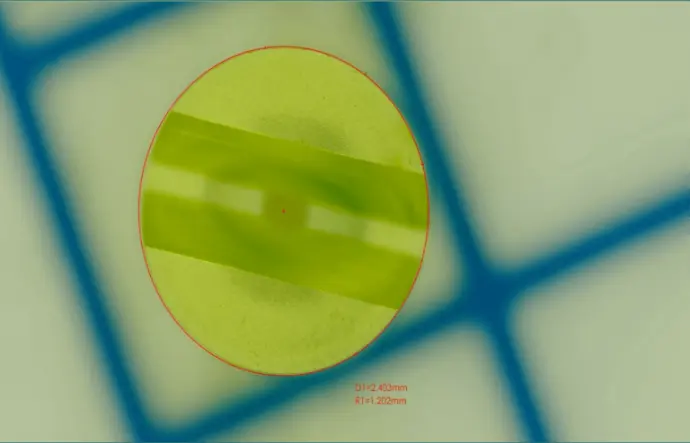
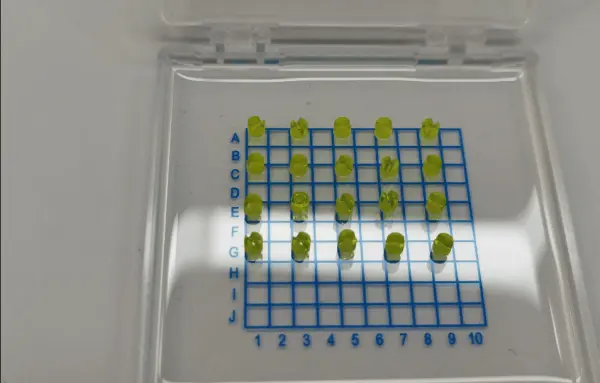
Diameter - 2.403mm, Radius - 1.202mm Micro 3D printed nozzles
Projection Micro Stereolithography (PμSL)
To achieve precision measured in tens of micrometers, Buchmann turned to BMF’s Projection Micro Stereolithography (PμSL), an additive manufacturing technology with several advantages:
- PμSL uses flashes of ultraviolet (UV) light to rapidly photopolymerize entire material layers
- Enables highly efficient processing in a short amount of time
- Utilizes specially formulated liquid polymers with superior mechanical properties
In addition, BMF’s Open Material System supports the use of third-party materials, expanding the application possibilities of the 3D printer.
Micro 3D Printing Process with BMF MicroArch S240
Buchmann collaborated with Boston Micro Fabrication to print 18 different 3D nozzle designs using the MicroArch S240, a desktop micro 3D printer specifically engineered for ultra-high resolution, accuracy, and precision.
BMF selected BASF Forward AM Ultracur® RG photopolymer resin, known for its durability and transparency in yellow or black variants.
Each spectroscopy component measured:
- 2.4 × 2.4 × 2 mm³
- Layer height: 10 µm
Remarkably, the total print time for all 18 parts was only 4 to 5 hours.
The RG photopolymer demonstrated excellent tensile and flexural properties, making it suitable for handling the pressures involved in spectroscopy applications. BMF successfully delivered all required components within just a few weeks.
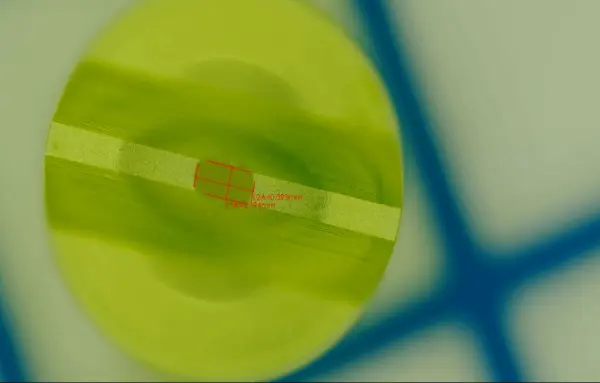
0.194mm x 0.393mm
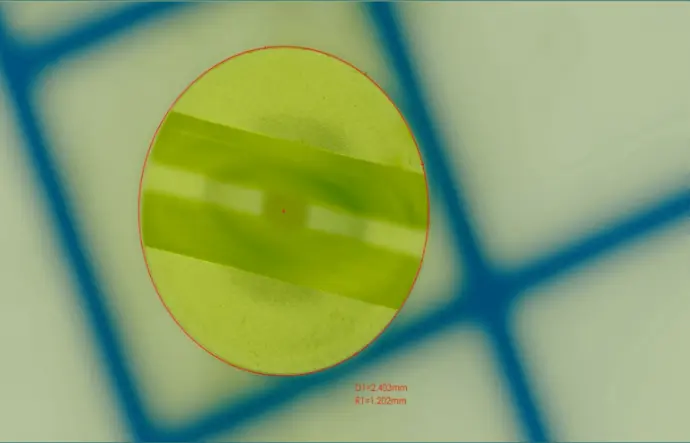
Diameter - 2.403mm, Radius - 1.202mm
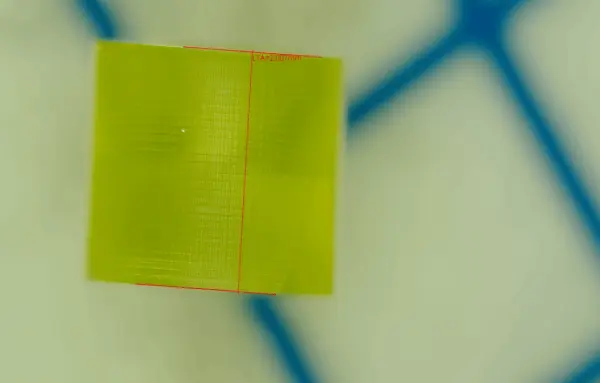
2.007mm
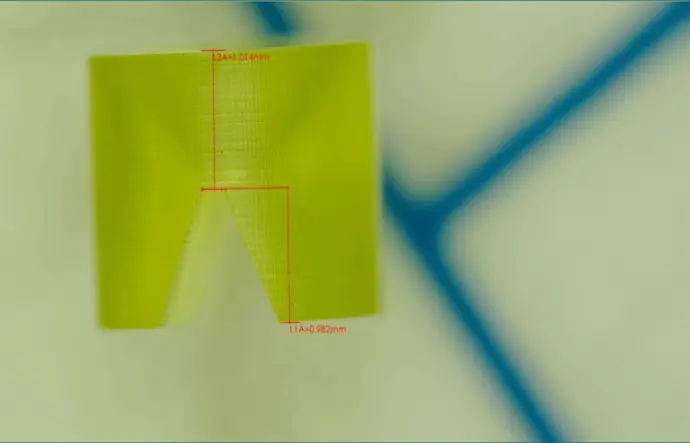
0.982mm
Spectroscopy Nozzle Results and Performance
Adrian Buchmann praised and validated the capabilities of BMF’s PμSL technology for delivering the required precision while rapidly producing multiple nozzle specifications using pressure-resistant polymers.
Currently, Buchmann is developing adapters to further evaluate the performance of the 3D printed nozzles. Once testing is complete, updated case studies will provide additional experimental insights.
The integration of Micro 3D Printing technology, particularly PμSL offers a significant advancement for spectroscopy research. Researchers can now obtain highly precise, customizable, and durable nozzles that replace traditional cuvettes.
With its ability to achieve exceptional accuracy and deliver outstanding results, Micro 3D Printing opens new possibilities for advanced scientific applications.
The final spectroscopy nozzle designs demonstrate the capability of micro 3D printing to create compact, high-precision components suitable for demanding research environments.
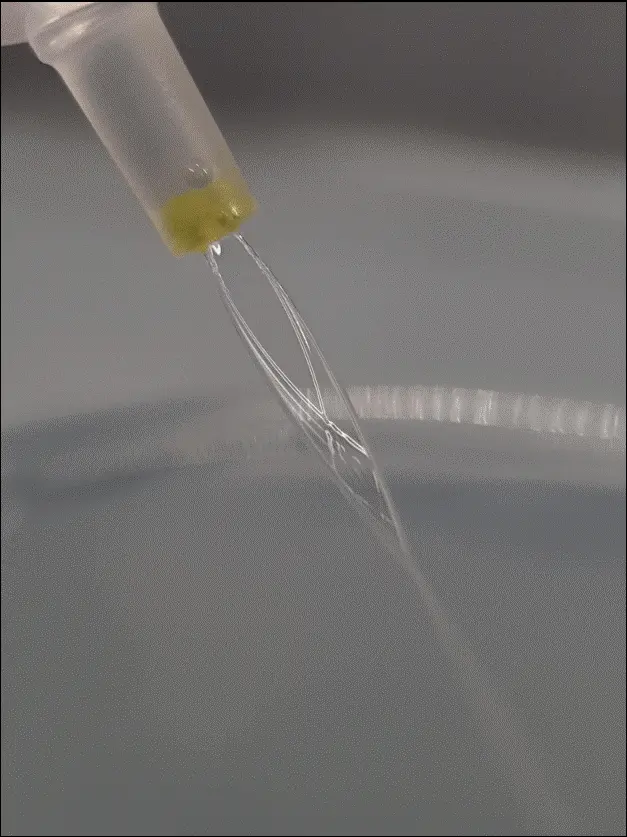
Final Result
3D Printer Supplier in Indonesia
Maha Chemicals is the official distributor of the MicroArch S240 from Boston Micro Fabrication in Indonesia.
In addition to producing highly precise nozzles, the BMF MicroArch system enables rapid production of various customized specifications. Contact us for more information and discover more about BMF MicroArch 3D printers with our experts today.
Need more support?
Let's connect!
We'll get in touch within 1 working day.
HQ Office & Laboratory
51 Tuas West Drive
Singapore 638415
Operating Hours
Monday – Friday | 8:00AM – 5:00PM
Contact
sales@dash-asia.co