4D Printing Research with Multi-Material Micro Fabrication from BMF
While the concept of 4D printing has been discussed in academia for years, its adoption has often been limited by material control, resolution, and repeatability. Many systems lack the precision needed to fabricate multi-material structures at micro scale, making it difficult to reliably study time-dependent behavior. This is where recent advances in multi-material photopolymer printing represent a meaningful turning point.
Recent advances in multi-material photopolymer micro-fabrication are now addressing these limitations, allowing 4D printing to move from conceptual demonstrations toward reproducible research systems.
Why Multi-Material Control Is Critical for 4D Printing
Time-dependent transformation is often driven by differential material response—one region expanding while another resists, or one material responding to stimuli while another remains stable. Without precise control over material boundaries, transformation becomes unpredictable and difficult to study systematically.
For researchers, repeatability is non-negotiable. Experimental structures must behave consistently across samples in order to validate models, compare results, and publish reliable data. This is where multi-material micro-fabrication becomes essential rather than optional.
MicroArch M150: Micro-Scale 4D Printing by BMF
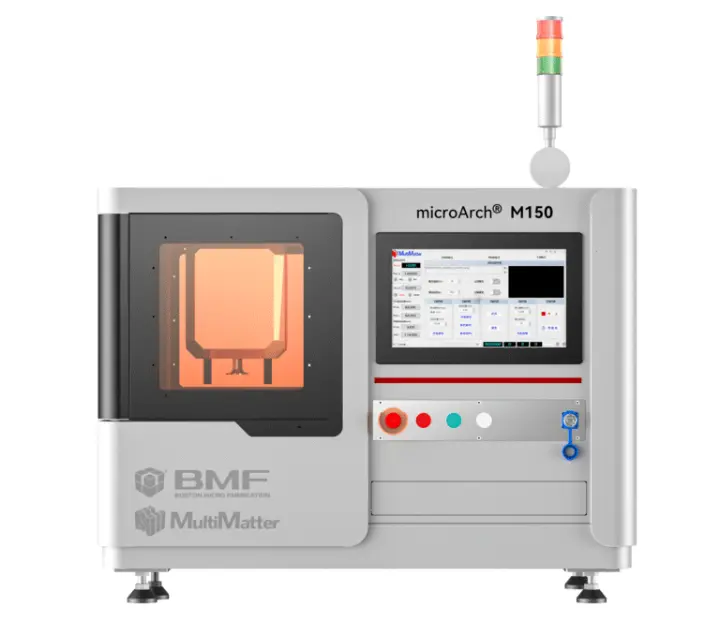
4d printing developed by Boston Micro Fabrication (BMF) enable micron-level resolution with highly controlled photopolymer placement. Systems such as the MicroArch M150 are designed to fabricate complex, multi-material microstructures in a single build process—supporting functional gradients, responsive zones, and mechanically coupled regions.
For 4D printing research, this precision allows behavior to be designed, not approximated. Researchers can intentionally engineer how structures bend, fold, or actuate under stimuli, enabling systematic investigation rather than trial-and-error experimentation.
The significance of platforms like the MicroArch M150 lies in their ability to transform 4D printing from a conceptual idea into a controlled research methodology. By enabling reproducible fabrication of time-responsive microstructures, researchers can move beyond one-off demonstrations toward scalable, publishable studies.
Discover how Dash Asia and BMF enable controlled 4D printing research at micro scale.
Get in touch for solutions
We'll get in touch within 1 working day.
HQ Office & Laboratory
51 Tuas West Drive
Singapore 638415
Operating Hours
Monday – Friday | 8:00AM – 5:00PM
Contact
sales@dash-asia.co